CoxandCoxUK was founded out of a desire to create a one-of-a-kind collection of homeware products that couldn’t be found anywhere else. The company encourages customers to discover their own personal style and to appreciate every corner of their home. Today, our collection continues to curate natural style for design enthusiasts of all tastes, paying close attention to every detail to create a look that is distinct, harmonious, and always one of a kind.
Our headquarters are in Frome, Somerset, and all of our products are still chosen with you in mind. Our design-led collections are inspired by tradition and fashion, and they provide new ways for interior enthusiasts to transform their homes and gardens. The season is captured in timeless aesthetic and effortless style with everything from inspirational furniture, lighting, storage, to accessories and other small items.
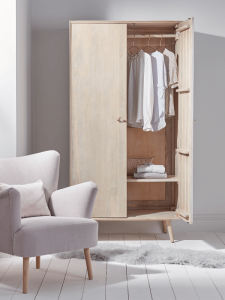
NEW Lowe Wardrobe
It is a Spanish luxury fashion house that produces leather goods, clothing, perfumes, and other fashion accessories. Loewe (/lov/, Spanish pronunciation: [loee]) is also known by the abbreviation LOEWE. Loewe is the oldest luxury fashion house in the world, having been established in 1846.
The company was founded in 1846 when a group of Spanish leather craftsmen in Madrid were joined by Enrique Loewe, a merchant of Hessian descent, to form the Loewe & Loewe company. By the early twentieth century, Loewe had piqued the interest of many notable people, including Queen Ena, who became a regular customer. In 1905, King Alfonso XIII granted them the Royal Warrant of Appointment, establishing Loewe as the official Purveyor of the Royal Household of Spain for the next ten years. The company quickly gained popularity, and celebrities such as Ernest Hemingway, Ava Gardner, Rita Hayworth, Marlene Dietrich, and Sophia Loren were among those who helped to promote it.
A wardrobe, also known as an armoire, is a standing closet that is used to store clothing. The earliest wardrobe was a chest, and it was not until a certain level of luxury had been achieved in regal palaces and the castles of powerful nobles that separate accommodation for the apparel of the great was provided. The term “wardrobe” was then applied to a room in which the wall space was occupied by closets and lockers, with the drawer being a relatively recent invention. [a citation is required] After a long period of time, from these cabinets and lockers emerged the contemporary wardrobe with its hanging spaces as well as sliding shelves and drawers.
While the enclosure’s physical appearance has changed over time, its primary function as a place to store a king’s robe has been maintained to some degree throughout the ages. The term has gained popularity over successive generations as an independent store for, among other things, preserving valuable items for a ruler, such as gold, which was particularly prominent during the reign of King Edward I. Additionally, it’s a straightforward patio, where clothes are hung from metal bars or tucked into utility racks that run from top to bottom. The modern wardrobe differs from the historical wardrobe in that it has three levels of partitioning: two linear compartments on either side with shelves, as well as a middle space with hanging pegs and drawers, the latter of which is a more recent addition, as well as a clothes press in the higher central space at the same level as a person’s chest.
The wardrobe, in its moveable form as an oak “hanging cupboard,” can be traced back to the early 17th century in the United States of America. During that time period, it was an early export product from America to England, due to over-harvesting of English woodlands and the use of forest resources for the Navy. It was as a result that the item was occasionally referred to as an oakley. These pieces, which were massive and cumbersome in form but often had beautifully carved fronts, were produced in small numbers for perhaps a hundred years, until the gradual decline in the use of oak for cabinet-making resulted in a shift in fashion toward the more abundant American walnut. The virgin American forests were transformed into Oak and then Maple forests as a result of successive deforestation episodes.
Despite the fact that walnut replaced oak as the preferred material for furniture, hanging wardrobes in walnut appear to have been produced only infrequently, whereas clothes presses with drawers and sliding trays were produced frequently.
During a significant portion of the 18th century, the tallboy was extensively utilised for the storage of clothing.
Here’s a preview of New lowe wardrobe by CoxandCoxUK:
NEW Flat Rattan Headboard
Seating (for example, Stools, Chairs, and Sofas), eating (tables), and sleeping are all examples of activities that furniture is intended to support for humans (e.g., beds, and hammocks). As well as holding objects at a convenient working height (as horizontal surfaces above the ground, such as tables and desks), furniture is used to store items and to hold things together (e.g., cupboards, shelves, and drawers). When it comes to furniture, it can be considered a work of decorative art and a product of design. In addition to serving a functional purpose, furniture can also serve a symbolic or religious function. A variety of materials, including metal, plastic, and wood, can be used to construct the structure. Furniture can be created using a variety of woodworking joints that are often influenced by the culture of the region.
Natural objects, such as tree stumps, rocks, and moss, have been used as furniture since the dawn of human civilization, and the practise continues today in some households and campgrounds. Archaeological research has revealed that people began to construct and carve their own furniture around 30,000 years ago, using materials such as wood, stone, and animal bones to do so. Early furniture from this period is known from artwork such as a Venus figurine discovered in Russia, which depicts the goddess seated on a throne, and other pieces of furniture. The earliest extant furniture can be found in the homes of Skara Brae in Scotland, and it consists of cupboards, dressers, and beds, all of which are made entirely of stone. Ancient Egypt’s early dynastic period is credited with the invention of complex construction techniques such as joinery. Constructed wooden furniture, such as stools and tables, was popular during this time period. The furniture was occasionally adorned with precious metals or ivory. Traditional thrones and the klinai, multipurpose couches used for relaxing, eating, and sleeping, were common in ancient Greece and ancient Rome, as was the evolution of furniture design. Furniture from the Middle Ages was typically heavy, made of oak, and ornately decorated. During the Italian Renaissance, which spanned the fourteenth and fifteenth centuries, the design of furniture grew in sophistication. The seventeenth century was characterised by opulent, often gilded Baroque designs, which could be found in both Southern and Northern Europe. The nineteenth century is typically characterised by the popularity of revival styles. A common interpretation of the first three-quarters of the twentieth century is that it marked the beginning of the march towards Modernism. The return to natural shapes and textures is one of the most distinctive outcomes of post-modern furniture design.
Here is a preview of New flat rattan headboard by CoxandCoxUK:

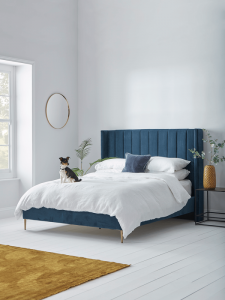
NEW Fluted Velvet Bed – Deep Blue
Natural objects have most likely been used as rudimentary pieces of furniture since the dawn of human civilization, according to historical evidence. Early humans are likely to have sat on tree stumps, used rocks as rudimentary tables, and slept in mossy areas, according to archaeological evidence. People began to construct and carve their own furniture during the late Paleolithic or early Neolithic periods, approximately 30,000 years ago, using wood, stone, and animal bones as building materials. It was a Venus figurine discovered at the Gagarino site in Russia that provided the earliest evidence of the existence of constructed furniture. The figurine depicts the goddess in a sitting position on a throne. A similar statue of a seated woman was discovered in Catal Huyuk, Turkey, and it is believed to have been erected between 6000 and 5500 BCE. The presence of such a seat in the figurines suggests that they were already common artefacts of the time period.
Skara Brae, a Neolithic village in Orkney, Scotland, has been excavated and a variety of unique stone furniture has been discovered. It is believed that the site dates back to 3100 to 2500 BCE, and that the people of Skara Brae were forced to build with stone due to a scarcity of wood in Orkney at the time. Stone was a readily available material that could be worked easily and turned into items for use in the home. Each residence demonstrates a high level of sophistication and is furnished with a diverse collection of stone furniture, which includes everything from cupboards, dressers, and beds to shelves, stone seats, and limpet tanks, among other things. This item was considered the most important because it symbolically faces the entrance in each house and is therefore the first item seen when entering, possibly displaying symbolic objects, including decorative artwork such as several Neolithic carved stone balls also discovered at the site, as well as other decorative objects.