History of Casa Batlló
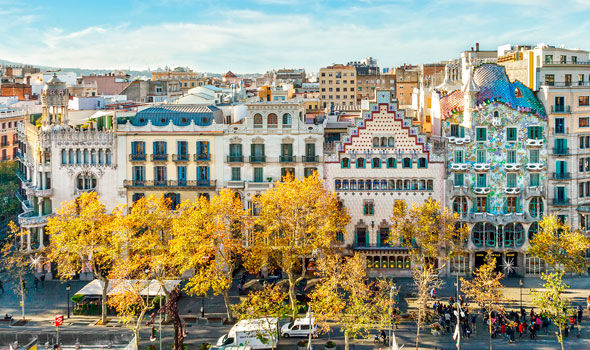
At number 43 on Paseo de Gracia, a street once linking the city to Villa de Gracia, which today is a completely integrated area of the city, Casa Batlló is situated.
Development of Paseo de Gracia
Paseo de Gracia has grown to be the backbone of Barcelona (known as the Cerdà Plan) since 1860, when an ambitious urban plan was approved. Here, Paseo de Gracia has attracted the most significant families to settle. In this sense, the street evolved from a major car route in the 20th century to a promenade for walkers and horses in the 19th century.
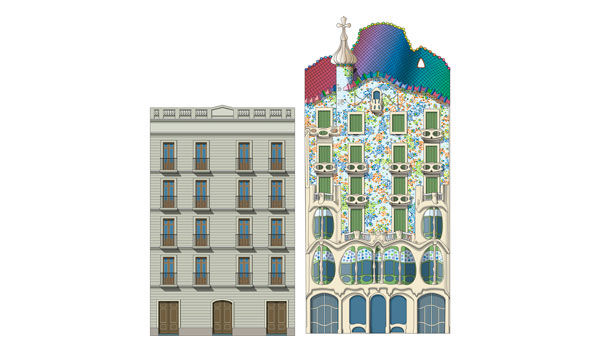
Originally constructed in 1877 by Emilio Sala Cortés, one of Gaudí’s architectural professors, the structure was completed while Barcelona lacked electric lighting. Purchased in 1903 by Mr. Josep Batlló y Casanovas, a well-known businessman with multiple enterprises in Barcelona, it was a textile industry.
Construction of Casa Batlló
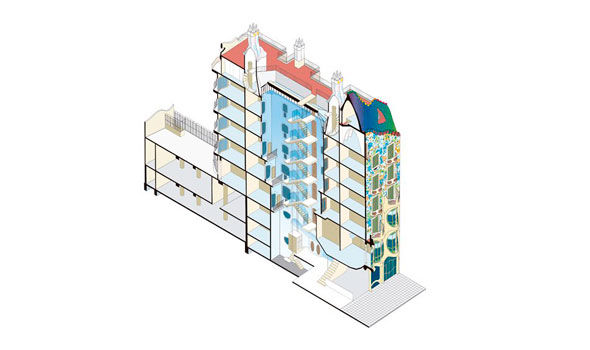
Antoni Gaudí was given a complete creative licence by Mr. Josep Batlló, who also assigned him responsibility for a project involving the first demolition of the construction. But because of Gaudí’s bravery, the home was completely rebuilt between 1904 and 1906 and its demolition was decided upon. Redistributing the internal partitioning, enlarging the lightwell, and transforming the inside into a genuine piece of art, the architect totally transformed the façade. Apart from its artistic worth, the structure is quite practical, far more modern than historical in character. Some even find aspects reflecting late 20th century architectural styles.
The Bone of Contention
Apart from Casa Batlló, eminent architects were also changing other buildings that were vying for the urban prizes called by the Barcelona City Council at the same time. This particular era was hence referred to as The Bone of Contention. Along with Casa Batlló, these modernist homes are now part of a distinct group shaped by:
- Casa Amatller (by the architect Josep Puig i Cadafalch).
- Casa Lleó Morera (by Lluís Domènech i Montaner).
- Casa Mulleras (Enric Sagnier).
- Casa Josefina Bonet (Marcel-li Coquillat).
Recent history
Casa Batlló was sold outside the Batlló family in the 1950s. Since the 1990s, the Bernat family—who have completely restored the house—have been the owners of the building after several businesses and people took it.
The family opened the house to the public in 1995 and showed this architectural jewel to the world, therefore providing the venue for events. Since 2002, in line with the International Year of Gaudí, Casa Batlló has also hosted cultural visits. Both events are open right now; offers and content are always changing thanks to ongoing innovation.
For those who wish to witness Gaudí’s work and modernity at its best, Casa Batlló is currently a UNESCO World Heritage site and a must-see in Barcelona. With one million visitors annually, it is also among the most highly ranked cultural and tourism sites.
A unique façade
Casa Batlló is a celebration of happiness, a painting of marine inspiration, and a dream universe conjuring nature and fantasy. Its façade serves as the portal to this symbolic cosmos, enveloping the observer with emotions set against a background of ongoing conversation with light and colour. Its amazing beauty will surely wow everyone who sees it and inspire others to think about it at any moment of the day.
Freedom and boldness
Thanks to his work as a free and happy artist, Gaudí offered Casa Batlló a distinctive façade filled with creativity. He therefore produced an energetic and marine-inspired façade, adding forced sculptures, discarded materials and decontextualized artefacts, thus turning them into art.
Its corrugated surface is very important since stone, glass, and ceramics take center stage there. The first light of the day brings the façade to life with a special shine and sparkle as well as with harmonic and balanced motion, as if it were a live component of the metropolitan environment. Combining light and colour transports you across the sea with beauty and happiness.
Main floors
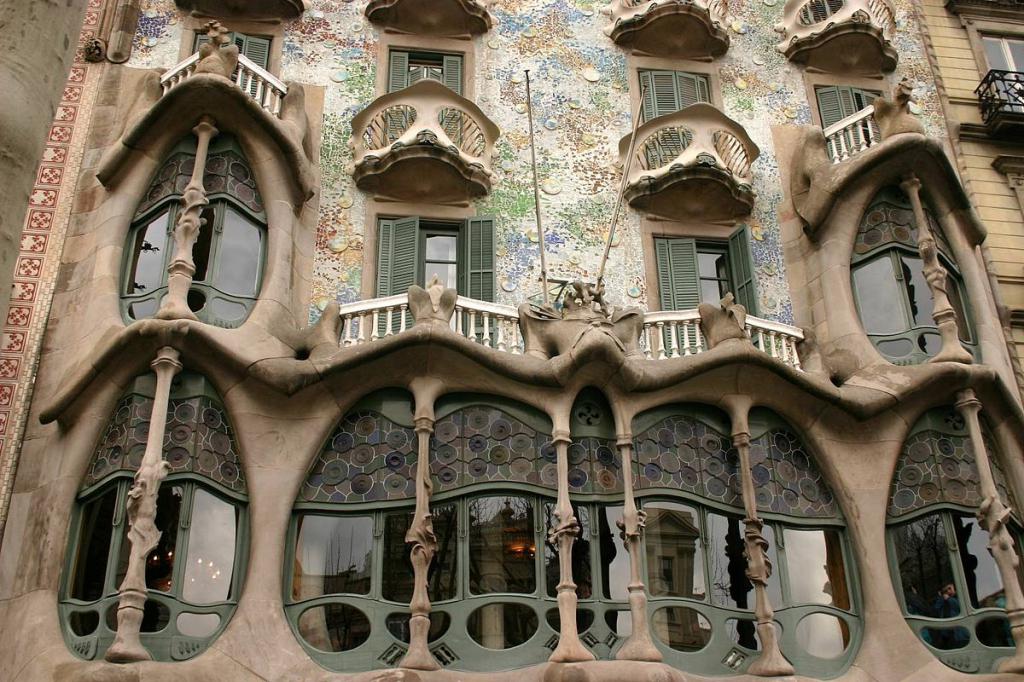
Ground level, first floor façades use thin stone columns shaped like bones, ornamented with distinctly modernist floral embellishments.
On the balcony, the rails form masks instead. Made from a single piece of cast iron, they are joined by two anchor points, therefore, part of them is projecting.
Gaudí included a large gallery on the Noble Floor, to view and be seen, projecting many metres over Paseo de Gracia. He also included big oval-shaped feature windows.
Roof
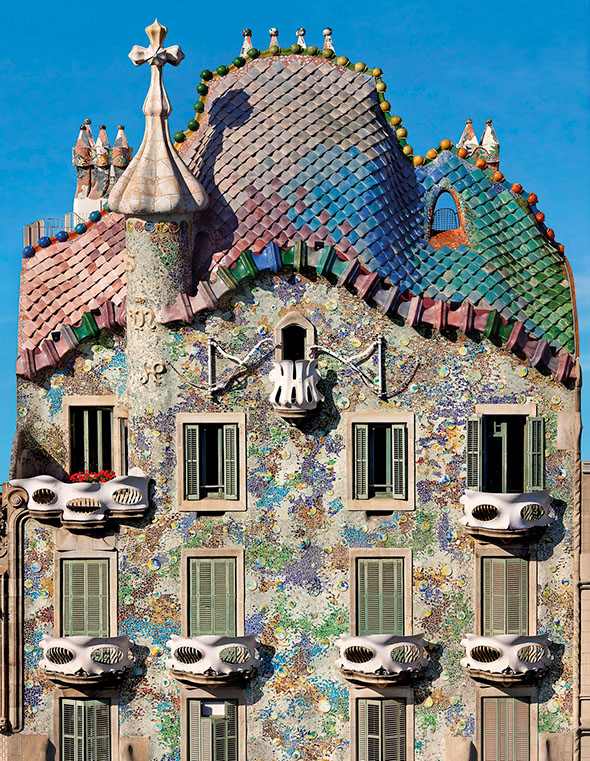
The building is capped with a magnificent roof made of big scales that mimic the rear of an animal. Large spherical elements with hues that vary from one end to the other define the upper portion. Rising from the other principal structure on the roof—a tower—a cross with four arms facing north, south, east, and west emerges.
An interior full of art
Casa Batlló’s inside is a wonder of design. Working with wrought iron, wood, stained glass, ceramic tiles and stone embellishments, among others, Gaudí teamed with the very greatest artists of the day.
Its features never cease to astound me when I explore the residence. Modernist elements abound on the doors leading to the several flats. Every landing’s windows distort the lightwell’s tiles, turning them into exquisite ripples of water. The baners and doorknobs have ergonomic forms. It is a real piece of art, in which the artist has engaged in every element: design, colour, shape, space and light.
Though the most shocking thing is that it is always based on utility, this exuberance will never stop astonishing you. From the entry hall to the roof terrace, beauty and utility coexist in every nook and cranny of the construction.
The Entrance Hall
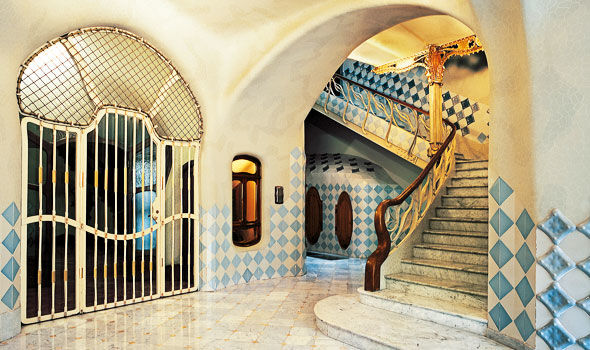
Through an outstanding modernist grid, the ground floor shared entrance hall connects to the private entrance hall of the Batlló family. The first stop on the tour is here. With skylights shaped like turtle shells, vaulted walls with curving forms and a magnificent wooden staircase, this area transports guests to the wonderful world of Jules Verne—an aquatic habitat. Made from mahogany, the carved bannister rises over inconceivable distances to symbolise the backbone of a large animal.
Indoor garden
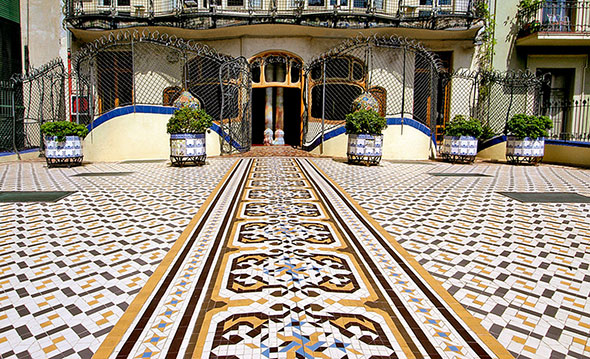
Located in the middle of the Noble Floor, the Batlló family’s private dining room gives access to a private garden located behind the house. This courtyard, a little oasis in the middle of the city, was built with intention by the Batlló family. It was built especially so they could enjoy afternoon activities. The paving, together with the tile and glass-coated flower pots, forms the centre point of this space since it is the main ornamental feature. These are the features that most clearly show themselves here right now.